The world of AI agents is currently at a major turning point. With the emergence of Salesforce Agentforce Actions and the evolution of skills in Microsoft Copilot, we are being forced to rethink how we design what “AI should do.”
In this article, we take the perspective that “Actions are broader than Skills” and explore why the coexistence of these two concepts is essential for next-generation business systems.
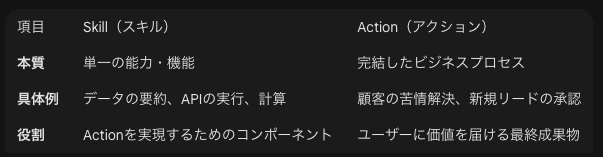
When building AI agents, the first thing to clarify is the hierarchical relationship between “what the agent can do (Skill)” and “what the agent must accomplish (Action).”
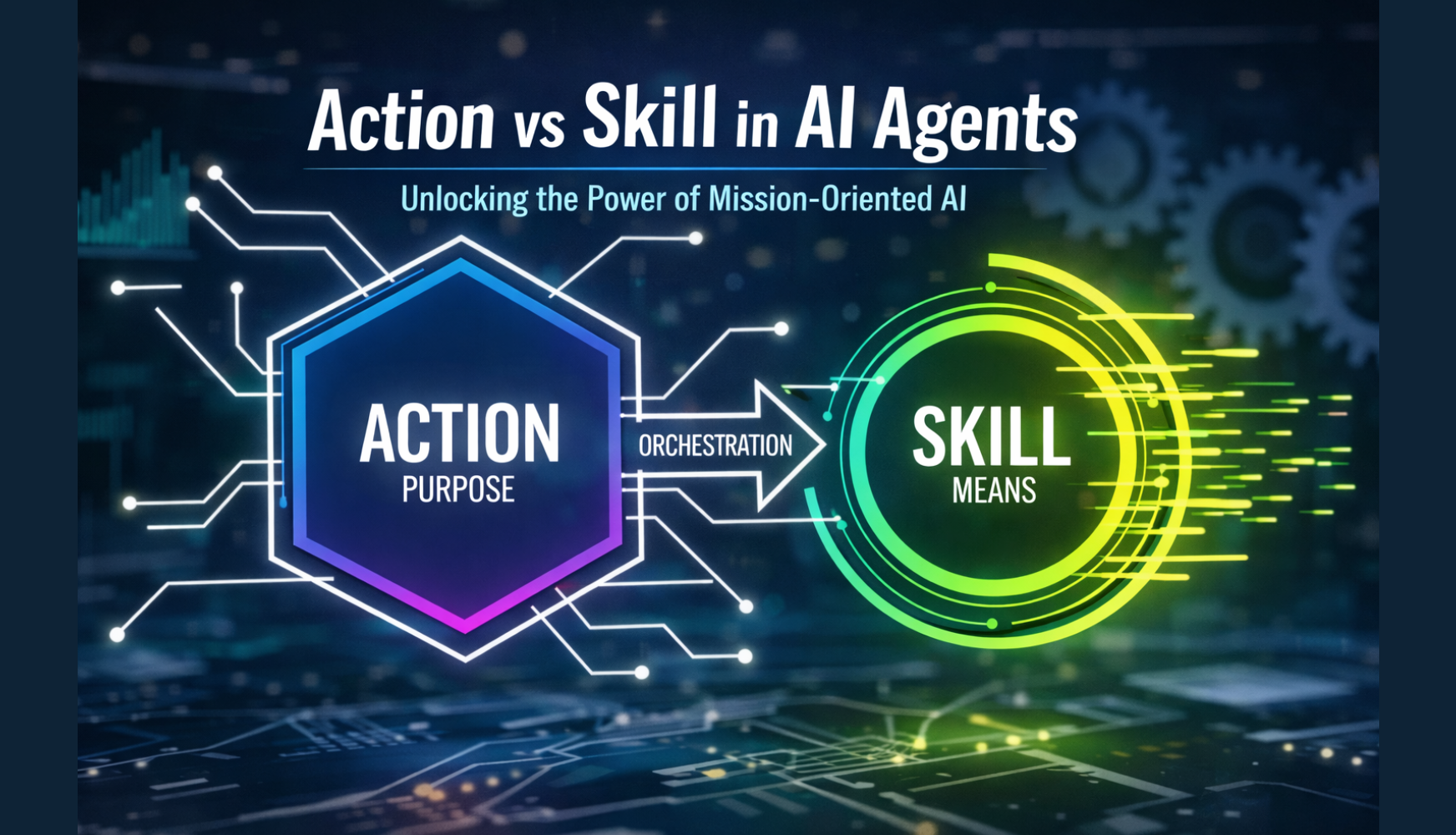
To understand how Actions encapsulate Skills, let’s visualize the internal behavior of an AI agent. In order to execute a single Action, the agent orchestrates multiple Skills behind the scenes.
System Architecture Image: Integrating Skills Through Actions
As shown in the diagram below, an Action acts as a “conductor,” dynamically invoking the most appropriate Skills depending on the situation.
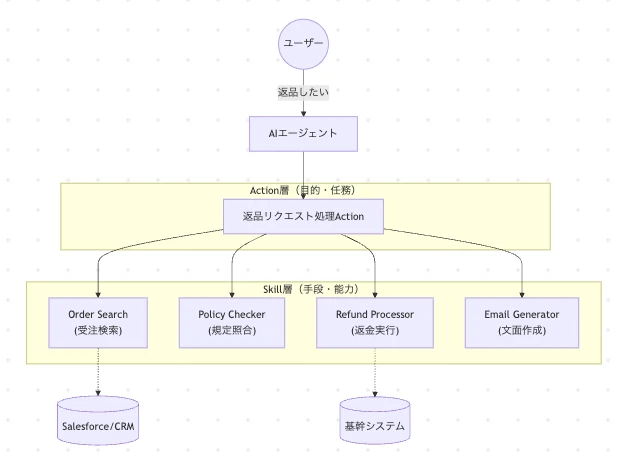
By functioning as a broad “container,” an Action allows individual Skills (APIs and tools) to be integrated into a coherent, context-aware business flow, rather than being used in isolation.
What changes occur when an Action (goal) is defined and multiple Skills are deployed to achieve it? Let’s look at three industry examples.
① Real Estate: Property Recommendation to Viewing Reservation
Action: Propose optimal properties tailored to the customer’s lifestyle and coordinate viewings.
Skills Used: Semantic search (property discovery), Google Maps integration (area insights), calendar synchronization (appointment scheduling).
② Manufacturing: Supply Chain Optimization
Action: Automatically detect inventory shortages and place optimal orders with suppliers.
Skills Used: Inventory monitoring, historical delivery performance analysis (data analytics), automated purchase order PDF generation.
③ Retail: Personalized Marketing
Action: Propose complete seasonal outfits based on past purchasing behavior.
Skills Used: Preference profiling, web browsing for latest trends, image generation (styling visuals).
We have moved beyond the phase of “what AI can display” and entered the phase of “what business processes AI can complete.”
Designing agents with a broad Action at the center and refined Skills within it—this philosophy of coexistence is the only way to unlock the true potential of Agentforce and Copilot, creating agents that function as genuine partners to humans.
Shift the focus of design from “functions (Skills)” to “missions (Actions).”
Now is the time to redefine the “Actions” that drive your business.
![[Urgent Analysis] The Reality of the Grubhub Data Breach: The Attack Did Not Begin with “Grubhub” Itself](https://furublog.s3.dualstack.ap-northeast-1.amazonaws.com/media/furu_blogs/7.The%20Reality%20of%20the%20Grubhub%20Data%20Breach.png)